
Most of what people believe about bathroom sinks is wrong
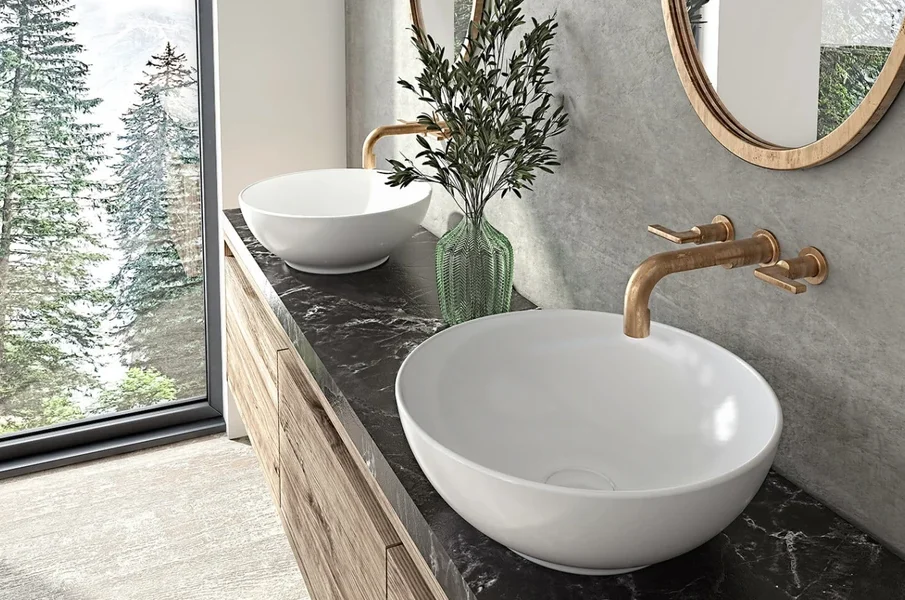
Here is a claim that will annoy some interior designers: the vessel sink, that bowl perched dramatically on top of the counter, is one of the most oversold bathroom features of the last twenty years. It photographs beautifully and frustrates people daily. And it is just one of several sink myths that lead homeowners to choices they quietly regret.
The bathroom sink seems too simple to get wrong. You pick one that looks nice, it holds water, done. Except the sink touches plumbing, counter space, faucet choice, cleaning, and ergonomics all at once. Let me push back on the assumptions that trip people up.
Myth: the vessel sink is the sophisticated choice
Vessel sinks look stunning in a magazine. In real life, they raise the effective height of the basin, which can put the rim uncomfortably high for shorter adults and nearly unusable for children. They splash more, because water has less depth to fall into. And the exposed base collects grime around a seam you have to clean constantly.
None of this makes them bad, exactly. In a powder room used mostly by guests, where drama matters more than daily function, a vessel sink can be perfect. But as the everyday sink for a family bathroom, it usually disappoints. The sophisticated choice is the one that fits how the room is actually used, not the one that wins the photo.
Myth: bigger sinks are always better
People assume a larger basin is more luxurious and more useful. Often the opposite is true. An oversized sink eats counter space you need for daily items, and it does not actually make handwashing better. Meanwhile, a deep, well-shaped basin of modest size contains splashing far better than a wide, shallow one.
Depth beats width for real function. A sink deep enough to keep water from spraying the mirror and counter serves you better than a broad basin that looks impressive and soaks everything nearby. Before assuming bigger is better, it is worth exploring the range of practical options. You can read more about basin shapes and depths and see how the sensible sizes compare to the showy ones.
Myth: the material barely matters
Some buyers treat the sink material as an afterthought, focusing entirely on shape and color. This is backwards. The material determines durability, stain resistance, and how much of your life you will spend cleaning it.
Vitreous china and porcelain earn their dominance for good reason. They are non-porous, tough, and easy to wipe clean. Glass looks gorgeous and shows every water spot and fingerprint. Natural stone brings character and may need periodic sealing. Concrete is on trend and can stain without proper care. There is nothing wrong with choosing a high-maintenance material, but do it knowingly, not by accident.
Myth: any faucet works with any sink
This one causes real headaches at installation time. The sink and faucet must agree on the number of holes and their spacing. A single-hole faucet will not mount on a sink drilled for a widespread three-hole set without an awkward cover plate. A vessel sink often has no holes at all, requiring a tall vessel faucet or a wall-mounted one.
People buy the sink and faucet separately, weeks apart, then discover they are incompatible. Always confirm the drilling configuration matches before buying both. Choosing them together, as a coordinated pair, avoids the classic scramble of a faucet that fits nowhere.
Myth: the undermount is fussy and expensive for no reason
Skeptics dismiss undermount sinks as a needless upgrade over the cheaper drop-in. Having lived with both, I would argue the undermount justifies itself through cleaning alone. With no rim sitting on the counter, you sweep water and debris straight into the basin with one motion. No grimy caulk line around a raised edge.
The catch is that undermounts pair best with solid countertops like quartz or stone, since the counter edge is exposed at the cutout. On a laminate counter, a drop-in makes more sense. So the myth is half true: the undermount is not universally better, but where the counter suits it, the daily convenience is real and worth the modest premium.
Myth: the overflow hole is essential
Many people assume that little hole near the top of the basin, the overflow, is a required safety feature. In residential bathrooms it is often optional, and sinks without one are increasingly common. The overflow does prevent flooding if a tap is left running with the drain closed, which is a reasonable concern in some households.
But the overflow channel is also a hidden cavity that collects gunk and grows mildew, and it is miserable to clean. A sink without an overflow, paired with the correct drain type, is simpler to maintain. Which you prefer depends on your household. Just do not assume the overflow is mandatory when it is frequently a choice.
Myth: the drain and installation are trivial afterthoughts
People obsess over the visible sink and ignore what happens below it, then wonder why they have problems. The drain assembly and the installation details cause more everyday frustration than the basin’s shape ever will.
Take the pop-up drain that comes with many faucets. The mechanism looks tidy but collects hair and grime and can be a nuisance to clean. Some homeowners prefer a simple grid drain for exactly this reason. Matching the drain type to the sink, particularly whether the sink has an overflow, is essential, because a mismatched drain either leaks or fails to work properly.
Then there is the clearance question. A deep basin or a vessel sink changes how much room remains below for the trap and supply lines, which matters in a tight vanity or a floating installation. I have seen beautiful sinks that left no practical space for the plumbing, forcing awkward compromises after purchase.
The lesson is that a sink is a plumbing fixture first and a decorative object second. Confirming the drain compatibility, the trap clearance, and the mounting method before buying prevents the installation-day headaches that turn an exciting upgrade into a frustrating one. The prettiest basin in the showroom is worthless if it cannot connect cleanly to the plumbing waiting in your wall.
The takeaway
A bathroom sink is never just a sink. It is a convergence point of plumbing, counter space, faucet, ergonomics, and cleaning habits. Nearly every popular assumption about sinks, that vessels are classy, that bigger is better, that material is cosmetic, that faucets are interchangeable, falls apart under everyday use.
The better approach is to ignore the photo-driven trends and ask how you will actually use the sink every morning. Choose depth over drama, confirm faucet compatibility, pick a material you are willing to maintain, and match the mounting style to your counter. Do that, and you will have a sink that disappears into daily life instead of reminding you of its flaws every single day.