The Real Cost of In-House Janitorial Staff vs. Outsourced Commercial Cleaning
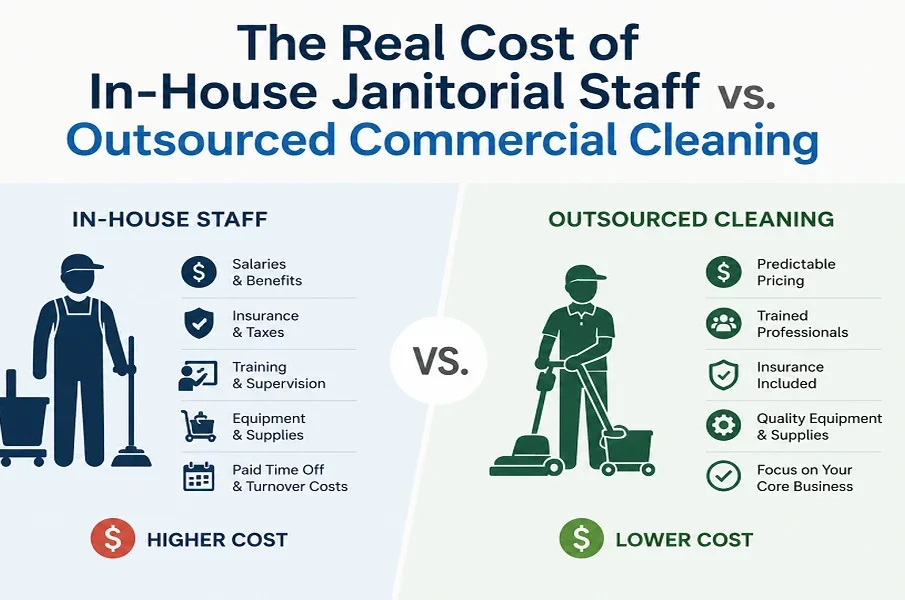
If you run a school district, an office building, or a commercial facility in Pennsylvania, you have probably stared at your custodial budget and wondered whether you are paying too much to keep the place clean. Most facility leaders only see the hourly wage on the line item. They miss the layers underneath. The true cost of an in-house janitorial team is almost always higher than the number on the paycheck, and understanding that gap is the first step in deciding whether commercial cleaning makes more sense for your building than continuing to hire and manage your own crew.
This is not a sales pitch. It is a plain breakdown of what in-house custodial staff actually cost, what you pay for when you outsource, and how to think about the tradeoff without getting swept up in either direction.
What In-House Janitorial Staff Really Cost
The hourly wage is the easy part. A union custodian in a Pennsylvania school district might earn around $16 per hour. That number looks manageable on a budget sheet. The problem is that it is only the beginning of the bill.
Benefits and Retirement
On top of that $16 wage, most districts pay roughly another $16 per hour in benefits. Health insurance, dental, vision, paid time off, and other benefit load add up fast. That puts the real hourly cost at about $32 before you account for anything else.
Then there is the state retirement contribution. In Pennsylvania public schools, the district pays a percentage on top of the employee’s compensation into the state retirement fund. That contribution has historically run around 20 percent. So on top of the $32 per hour you are already paying, you add another chunk to the retirement system. The exact percentage shifts year to year, but the structure is the same. The wage on the line item is not the cost of the employee.
Workers’ Compensation
Janitorial work has one of the highest workers’ compensation claim rates of any occupation. The reason is repetitive motion. Mopping, lifting, bending, and running equipment day after day wears on the body. An older workforce, which is common in custodial roles, tends to file more claims and more serious claims. Every claim affects your experience modifier, which drives your insurance premium higher over time. That cost lives on your books, not the employee’s.
Overtime and Coverage Gaps
Here is where the budget really starts to bleed. When the union cannot hire enough people, and in many districts it cannot, the existing team picks up the slack. That means overtime. Overtime is time and a half, sometimes more, and it compounds the benefit and retirement load.
The deeper problem is what happens to the people working the overtime. A short staffed custodial team gets overworked. Overworked custodians get hurt, get sick, or quit. When someone quits, the gap gets worse, the overtime goes up, and the cycle repeats. Facility managers know this loop well. It is the quiet cost that never shows up on a single invoice but eats the budget over a school year.
Hiring and Turnover
Every time a custodian leaves, you pay to replace them. Job postings, screening, interviews, background checks, drug testing, onboarding, training. If your HR team is already stretched, this is work they do not have time for. And if the new hire does not work out, you start the cycle again. In a tight labor market, the time to fill a custodial opening can stretch weeks or months, and during that gap you are paying overtime to cover the empty shift.
What You Pay For When You Outsource
Outsourced commercial cleaning flips the cost structure. Instead of loading every cost onto your own payroll, you pay a single rate to a vendor who carries the people, the benefits, the insurance, and the replacement risk.
A Flat Hourly Rate With No Hidden Load
A typical outsourced janitorial rate in Pennsylvania runs in the neighborhood of $30 per hour. That is the number. There is no separate benefit line, no retirement contribution, and no workers’ comp premium sitting on your balance sheet. The vendor carries all of it.
At first glance, $30 an hour can look higher than the $16 wage you pay a union custodian. Compared apples to apples, though, you are already paying more than $32 an hour for that in-house employee before the retirement contribution. The outsourced rate is competitive, and in many cases lower, once you account for the full loaded cost.
No Benefit or Retirement Obligation
This is the line that catches the attention of business managers and CFOs. When you bring in an outside cleaner, that person is not on your payroll. You do not pay their health insurance. You do not contribute to their retirement. You do not carry their workers’ comp claims on your experience modifier. Those obligations sit with the vendor. For a district staring down rising benefit costs and retirement contributions, that shift can be meaningful.
Coverage Without the Hiring Burden
The vendor finds the people. They screen, drug test, onboard, and train. If someone calls out, the vendor is responsible for filling the shift. If someone quits, the vendor replaces them. Your facility manager is not posting jobs at 9 p.m. on a Sunday because a custodian did not show for the Monday morning opening. That operational relief is hard to price but easy to feel.
Supplemental, Not Replacement
This is the part that matters most in union environments. A good commercial cleaning partner does not come in to take over. They come in to fill the gaps the existing team cannot fill. In many Pennsylvania school districts, the contract requires the district to offer an open shift to a union worker first. If the union can fill it, the outside crew steps back. If the union cannot, the outside crew fills it. The in-house team keeps their work, their seniority, and their path. The outside crew simply makes sure the building gets cleaned when there are not enough hands to do it.
That framing matters. The conversation is not about replacing your people. It is about making sure the work gets done when your people are not enough.
When In-House Still Makes Sense
Outsourcing is not always the right answer. If your district has a stable, fully staffed custodial team, low turnover, manageable overtime, and a benefit structure you can absorb, the in-house model works. There is value in a crew that knows the building, knows the staff, and has been there for years. Continuity counts.
In-house also makes sense when you have the HR bandwidth to handle hiring, the budget to absorb benefit increases, and a workers’ comp history that is not driving your premiums up. If none of those are true, the math starts to favor outsourcing.
When Outsourcing Starts to Win
The case for outsourcing gets stronger when any of these are true.
- You are chronically short staffed and the union cannot hire fast enough to keep up.
- Your overtime line is climbing every quarter and you cannot get it back down.
- Your workers’ comp claims are rising and your premium is following.
- Your HR team is spending more time on custodial hiring than on their core work.
- Your benefit and retirement costs are rising faster than your budget can absorb.
- You have a building or a wing that needs coverage and you cannot get a body in the door.
If two or three of those sound familiar, the full loaded cost of your in-house team is probably higher than you think, and a flat rate from an outside vendor is worth a real comparison.
How to Do the Comparison Honestly
The mistake most facility leaders make is comparing the outsourced rate to the in-house wage. That comparison will always favor in-house, and it will always be wrong.
The honest comparison is outsourced rate against fully loaded in-house cost. Wage plus benefits plus retirement contribution plus workers’ comp plus overtime plus hiring and turnover plus the management time your team spends covering gaps. When you add all of it, the gap between the two numbers shrinks, and in many cases flips.
Start with one building or one shift. Get a quote for outsourced coverage on that scope. Then run your real in-house cost for the same scope, loaded. Put the two numbers side by side. That is the only comparison that tells you the truth.
The Bottom Line
In-house custodial staff give you control and continuity. They also carry a cost stack that most budgets do not fully capture. Outsourced commercial cleaning gives you a flat rate, coverage without the hiring burden, and relief from benefit, retirement, and workers’ comp obligations. The right answer depends on your building, your team, and your budget, but the right answer only shows up when you compare the real numbers, not the line item.
If your overtime is climbing, your hiring is stalling, and your benefit costs are rising, it is worth running the math. You may be paying more to keep cleaning in-house than you would to hand the gap to a partner.